
What Italy and Greece Taught Me About the Beauty of Imperfection
Written by Jacqui Toumbas, food and travel creator and founder of Savour the Slow, hosting women’s retreats in Italy and Greece.
I’ve come to believe that some of the most meaningful experiences in travel and in life are found in imperfection.
This is a reflection on what Italy and Greece have taught me about beauty, simplicity, and why slowing down often gives us more than striving ever does.
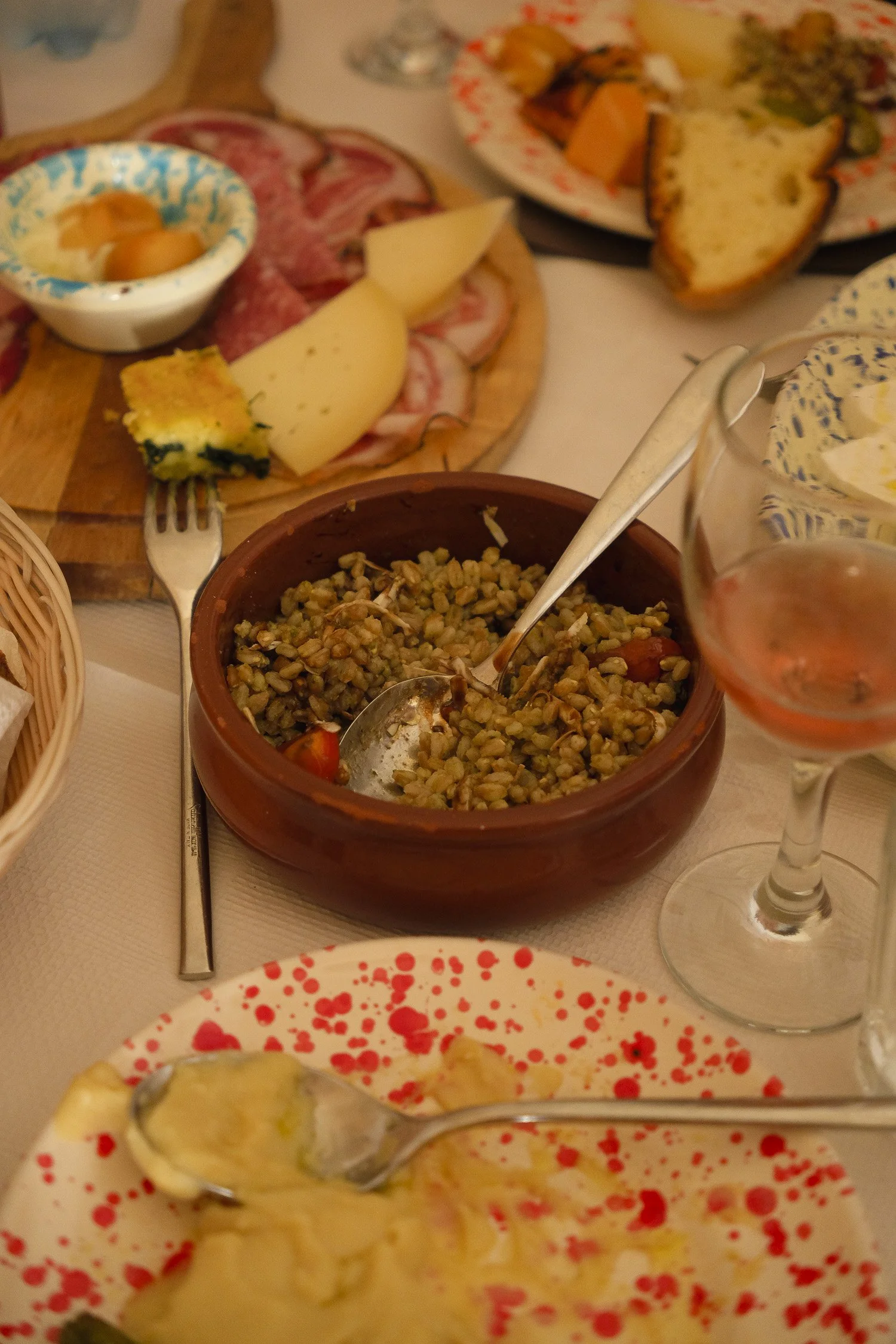
We were hot, hungry, and tired the afternoon we stumbled into a tiny taverna in Grottaglie. The morning had been spent wandering among shelves of local ceramics, running our hands over bowls and plates glazed in Mediterranean blues and terracotta reds. When the heat became unbearable, we found ourselves shoulder to shoulder with strangers in a cramped room, nine of us crammed around a table barely meant for six.
A table meant for six
There was no menu. “You eat what we bring,” the waiter said, shrugging. At first, I panicked. What have I done, bringing my guests here? But then plates began to appear, bread still warm, creamy fava beans, a tumble of vegetables, meat cooked so simply yet so perfectly it made us all go silent. Everything arrived on mismatched plates, chipped at the edges. Nothing was plated “beautifully.” But it was, without question, one of the best meals I’ve ever had.
When perfection isn’t the point
It was in that moment that I noticed the contrast most clearly: in Australia, we obsess over perfection. We expect meals to look like they belong in magazines. Here, flavour trumped form. The imperfection was the charm.
Homes that feel lived in
Later, at the Masseria, Maria invited me into her home. The first thing I noticed wasn’t a particular object, but a feeling. Layers and textures, worn furniture, uneven walls, shelves lined with jars. A warmth that wrapped around me the moment I stepped inside. It was rustic, yes, but it was alive, soulful. Nothing about it resembled the sleek, curated homes we celebrate back in Australia. And yet it was one of the most beautiful spaces I’ve ever entered.
A different definition of luxury
On Andros, I felt the same. Our accommodation was just two simple rooms with an outdoor kitchen. No dining room. No television. Not even a proper lounge. Just a table shaded by trees, and an uninterrupted view of the sea. We spent hours cooking, eating, and reading with nothing but the sound of waves crashing below. Imperfect by any “standard,” and yet more perfect than any five-star stay I could imagine.
The quiet pressure we carry
In Australia, I know the opposite feeling all too well. There’s an unspoken pressure that everything, our food, our bodies, our homes, must meet some impossible standard. The idolised Australian woman is a size six, blonde hair, blue eyes. Yet the average Australian woman is a size 14. We are so consumed by appearances that imperfection is seen as failure. Food is judged by how it looks on Instagram, not how it tastes. Homes are curated like showroom floors. Even bodies are styled, filtered, and reshaped for public consumption.
I often wonder if we even realise it anymore, or if the obsession has become so normalised that we no longer see it. For me, it feels suffocating. Sad. A culture of surface over substance.
Why I created these retreats
It’s part of why I created my retreats, to offer my guests a different rhythm, a reminder of what beauty really is. I want to break that “ideal world” we’ve built in Australia and show them the magic of simplicity: the table with mismatched plates, the meal without garnish, the home with worn edges but a beating heart.
I believe embracing imperfection is partly about slowing down, yes, but also about letting go, of the expectations we carry in our daily lives. At home, I am the business owner, the daughter, the friend. I juggle responsibility, roles, and appearances. But when I step off a plane in Puglia or on a Greek island, I am free. Free to eat without judgment. Free to exist without performance. Free to be myself.
When doing nothing is enough
An Italian man once put it bluntly, in a way only Italians can. He laughed at the way some cultures fill their days with activities, axe throwing, breweries, anything to feel like they’re “doing something.” “In Italy, we go for a walk. We have a coffee. We talk. We meet people. We eat. We go to the beach, we read a book. We do nothing and that is enough,” he said. Then, with a bite of humour that cut close to the bone: “Your society thinks a walk is boring. You wonder why you’re all depressed. You believe if you don’t spend $200 on an activity, you’re not happy.”
Crude? Perhaps. But he was right. In Australia, we complicate joy. We commercialise it. We measure its worth in how much it costs or how polished it looks.
Here, joy is free. Joy is a plate of fava beans, a chipped bowl of vegetables, an afternoon with no plan but the sea.
What I’m still learning
It’s these moments, unpolished, unplanned, deeply human, that have shaped the way I now travel, and the experiences I create for others.
As I return home, I carry these questions with me. What would it look like to live with imperfection? To let go of the polish and lean into the organic, the authentic, the free? I don’t have the answer yet. But I know this: the most beautiful moments of my travels were never the ones that looked perfect. They were the ones that felt perfect.
And maybe that’s the point.
Thanks for reading.
If this piece resonated, I hope it encourages you to notice the quiet, imperfect beauty around you, wherever you are.